
Moving to Denver, Colorado: A Complete Guide to Highways, Neighborhoods, and Suburbs
Ryan Haarer June 19, 2026
Ryan Haarer June 19, 2026
The Denver metro area is home to more than 3 million people spread across six counties, dozens of suburbs, and four major highway corridors. For most people relocating to the region, understanding how all of those pieces fit together is the first step before starting a serious home search.
Many people moving to Denver arrive expecting mountain views right outside the airport. Instead, they land to find flat, open plains in every direction. Denver International Airport sits roughly 25 miles from downtown on the metro's northeastern edge, surrounded largely by farmland.
Colorado is known for the Rockies, but Denver itself sits on the high plains, with the mountains positioned well to the west. The drive from the airport into the city runs west on Interstate 70, typically about 35 minutes without traffic. The landscape shifts noticeably along that route — flat and open to the east, increasingly mountainous to the west. That east-to-west shift plays a major role in how residents choose where to live.
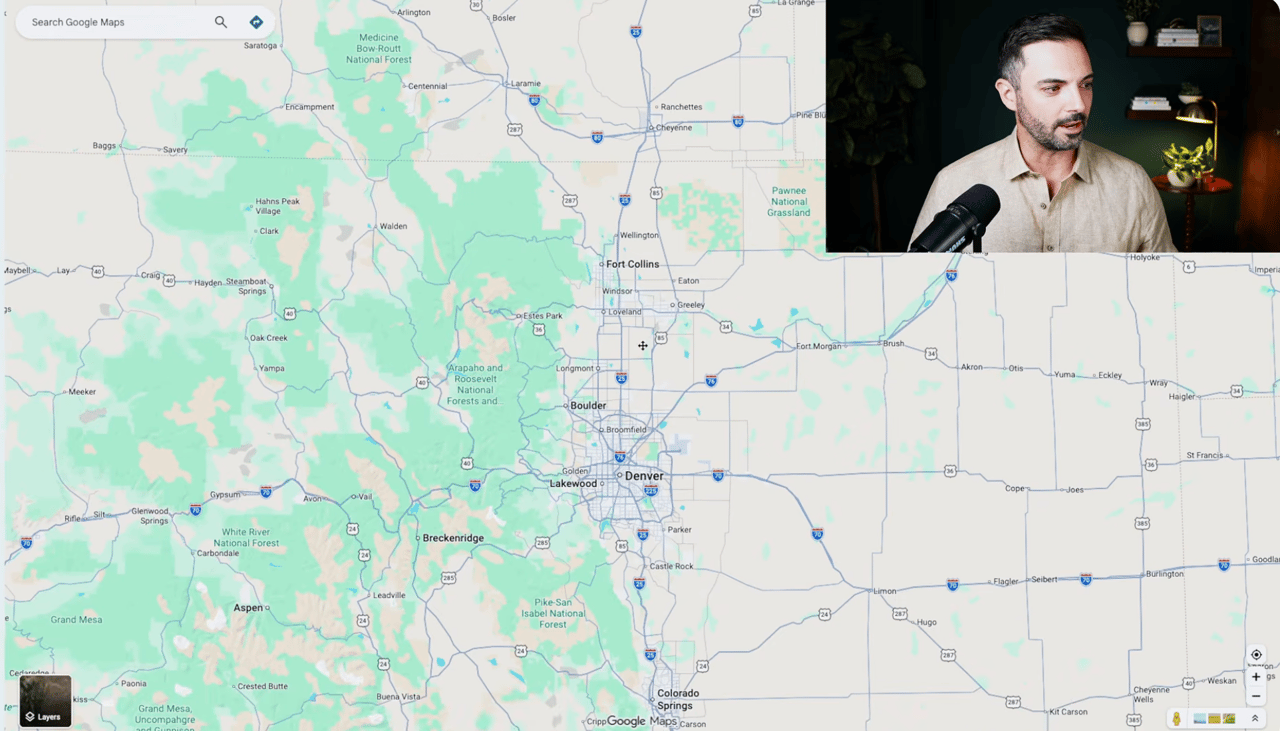
Three major highways shape how the Denver metro area connects, and understanding them makes it far easier to evaluate suburbs, commutes, and neighborhoods.
Interstate 25 runs north and south and serves as the metro's main spine, connecting southern suburbs, downtown Denver, northern suburbs, and points as far north as Fort Collins. Rush-hour traffic along I-25 can be significant, particularly near the downtown core.
Interstate 70 runs east to west and provides direct access to Colorado's mountain towns, including Breckenridge, Vail, and Keystone. Traffic on I-70 increases significantly on Friday afternoons and weekend mornings as residents head to ski resorts, and again in summer for camping trips. Traffic generally eases during the spring "mud season."
E-470 is a toll road that loops around the metro's eastern edge, offering a faster route between the airport and southern suburbs without passing through downtown. The corridor connects Aurora to the east, Highlands Ranch to the south, and Lakewood to the west, typically with lighter traffic and higher speed limits than the interstates.
Beyond the highway system, the county a buyer lands in can affect taxes, schools, and more — a factor covered in detail below.
Downtown Denver, centered around the historic Union Station, anchors the urban core. Built in 1881, Union Station now houses hotels, restaurants, bars, and retail within a single historic building. Adjacent to it sits Lower Downtown, known as LoDo, Denver's oldest neighborhood, home to Coors Field and a mix of converted brick warehouses, walkable streets, and local restaurants.
Across the Highland Bridge sits Northwest Denver, home to neighborhoods including Berkeley, known for remodeled older homes and new luxury construction near Tennyson Street, and Lower Highlands, or LoHi, a trendy area known for nightlife and low-maintenance luxury townhomes.
East of downtown, Capitol Hill offers dense, historic housing, art galleries, and some of the city's highest walkability scores, including original late-1800s Victorian homes. RiNo, the River North Art District, has emerged as a creative hub, with former industrial buildings now housing breweries, galleries, and food halls, alongside extensive mural art.
To the southeast, Cherry Creek North has developed into one of the city's most upscale areas, with high-end shopping, a strong restaurant scene, and growing interest from banks and tech companies relocating to the area's office buildings.
To the east, Central Park offers a notably more suburban feel within Denver's city limits, featuring a master-planned layout with newer homes, parks, pools, and schools, positioned conveniently between downtown and the airport along I-70.
For many residents, Colorado's mountains aren't simply scenery — they're a primary reason for living in the region. West of the metro along I-70, the terrain shifts quickly into dramatic high-country landscapes.
Several ski resorts are close enough for day trips. Loveland Ski Area sits about an hour to an hour and a half away without traffic, while Breckenridge and Keystone run roughly an hour and a half to two hours, and Vail sits closer to two hours depending on conditions.
Red Rocks Park and Amphitheatre, about 15 miles southwest of downtown in Morrison, seats roughly 9,000 people between massive sandstone formations and is widely regarded as one of the best concert venues in the country. As a public park, it also offers hiking trails and a popular outdoor stair workout when no event is scheduled.
Rocky Mountain National Park sits about an hour and a half northwest and draws both day-trippers and families planning ahead, since park passes and camping permits often sell out in advance. Closer to the city, Chatfield State Park is about 22 miles from downtown and offers boating, camping, and trails, while Jefferson County maintains an extensive network of hiking and biking trails reaching into the foothills.
Denver sits at 5,280 feet in elevation, with mountain towns positioned even higher. Newcomers, particularly those relocating from sea level, are generally advised to allow a couple of weeks to adjust, drink more water than usual, pace early hikes conservatively, and moderate alcohol consumption at first.
Two homes located just a few miles apart can fall into different school districts with different tax structures and funding levels, making county boundaries an important factor early in a home search.
Denver is a consolidated city and county, encompassing the core urban neighborhoods, including LoDo, LoHi, Capitol Hill, RiNo, and Washington Park. Its boundaries extend east to the airport and loop north to include Central Park.
To the west and southwest sits Jefferson County, known locally as Jeffco, covering Golden, Lakewood, Arvada, and Littleton. Jeffco Public Schools is the second-largest district in Colorado. Broomfield County, smaller in size, has seen growth along the US-36 tech corridor toward Boulder, home to companies including Oracle and Vail Resorts.
To the north and northeast, Adams County covers Brighton and Thornton, offering more affordable, suburban housing, often in the $400,000-to-$600,000 range. South of Denver, Arapahoe County includes Englewood, Centennial, parts of Littleton, and Aurora, and is home to the highly regarded Cherry Creek School District. Further south, past E-470, Douglas County covers Highlands Ranch, Parker, Castle Rock, and Castle Pines, known for newer construction, larger homes, and top-ranked Douglas County Schools.
Centennial, about 30 minutes from downtown near the Denver Tech Center, offers a mix of mature, well-maintained 1970s-era homes within the Cherry Creek school district. The median home price sits around $700,000.
Highlands Ranch, one of the metro's best-known master-planned communities, was largely built out in the 1990s and offers extensive trails and recreation centers. Backcountry, a section of Highlands Ranch backing to open space, offers a more private, higher-priced luxury option.
Parker, southeast of Highlands Ranch, works well for buyers commuting a few times a week rather than daily, with strong access to the Denver Tech Center. New construction in the $600,000 range offers solid value, while luxury communities like Pradera and the Colorado Golf Club can run into the millions.
Castle Rock, the southernmost suburb in the metro, has seen rapid new construction and strong value, with homes exceeding 3,000 square feet available around $600,000. Nearby Castle Pines Village offers a higher-end, golf-oriented lifestyle, with prices starting around $1.5 million and reaching as high as $7 million.
Littleton, on the west side of I-25, offers a wide range of home types and price points, from $600,000 to $1.5 million, depending on the area. Newer construction near Chatfield Reservoir offers mountain views, while Ken Caryl provides a more established suburban feel. Main Street Littleton retains much of the area's original character, with walkable shops and restaurants. Luxury neighborhoods including Roxborough Park, Bowmar, and Ravenna offer high-end homes with significant views.
Lakewood, directly west of Denver along I-70, has a median home price in the high $500,000s. Belmar offers a walkable, urban-style hub within the suburb, while Green Mountain, closer to the foothills, offers strong value in the low $600,000s.
Wheat Ridge, just north of Lakewood, offers quick access to both I-70 and northwest Denver at a discount to Denver pricing, with townhomes in the $500,000s and larger custom homes reaching beyond $2 million.
Arvada, in the northwest suburbs, has drawn increasing interest around Olde Town Arvada, with walkable shops and restaurants and nearby homes in the low-to-mid $600,000s, alongside newer, larger construction farther north.
Golden, near the base of Clear Creek Canyon, offers a walkable downtown, the Coors Brewing Company, and Colorado School of Mines, with home prices reflecting its proximity to the mountains, often starting in the low $1 million range.
Aurora, one of the largest cities in Colorado by land area, becomes more suburban toward the southeast near E-470, with golf courses and established neighborhoods offering relative affordability. Homes can start in the mid-$400,000s, making Aurora one of the metro's most affordable options, though commute times to downtown can approach an hour without traffic. Proximity to the CU Anschutz Medical Campus, one of the region's largest employers, is a significant draw for many buyers in the area.
Denver's layout rewards buyers who understand the map before they start touring homes. Highway access, county lines, and proximity to the mountains all factor into which suburb makes the most sense for a given commute, lifestyle, and budget.
Ryan Haarer is one of the top 1.5% of realtors by volume in the country, according to RealTrends, and works with buyers and sellers in the Denver metro area. Reach out for a personalized consultation by calling or texting Ryan at 303-507-5910 or emailing him at [email protected].
Stay up to date on the latest real estate trends.
From major residential projects and infrastructure upgrades to new dining and retail, a comprehensive look at what’s changing across the Denver metro this fall
Five Denver metro neighborhoods positioned for long-term appreciation, and what it takes to protect that return after you own the home
A region-by-region breakdown of the Denver metro area, from the urban core to the far suburbs, with home prices and lifestyle details for every area
He pays great attention to detail, ensuring his clients make sound, smart real estate choices and investments. Contact him today to discuss all your real estate needs!